
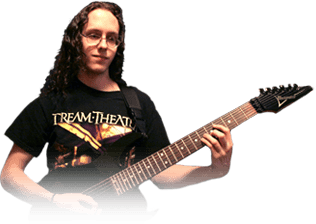
Robert Mussatti
Guitar Instructor
Select Instructor
Robert's Music
About Robert
Hello, and welcome to my domain of guitar!
Where to begin…I started playing guitar when I was 13 years old. The first year or so was very rocky. I had guitar lessons from a guy whom my grandmother had worked with, and took those for about a year. I had to quit and for the next 3 or 4 years through high school, I learned from many books including the Troy Stetina series.
But it wasn’t until I attended MATC to study music when I finally opened my eyes to guitar and embraced all types of music. When I was there, I really honed my chops and soaked in so much knowledge about theory, composition, arranging, sight reading, and performing.
I play many styles of music, but specialize in hard rock and heavy metal. But within my playing, I use many techniques used in traditional jazz, classical, and blues.
My main goal with this site is to help transform you into not just guitar players, but into real musicians. To where your music will be able to take you anywhere your dreams and hearts desire. So a few things we might be going over outside of the guitar medium are: sight reading, ear training, voice leading, transcribing, etc.
My main influences as guitar players are: Joe Satriani, John Petrucci, Marco Sfogli, Steve Peplin, Yngwie Malmsteen, Kirk Hammett, Devin Townsend, Steve Vai, Marty Friedman, Jason Becker, Reb Beach, Dave Pritchard.
Robert's Lessons
Display
Type
Sort
Hello and welcome to this tutorial on building speed and accuracy. One thing that alot of people ask is "How do I get faster?" and of course, the almost automatic reaction is "Practice!" and...

Now, something that has helped me as far as building speed is first picking a set picking pattern, like this one: This one is just a basic 16th note chromatic run up the neck starting on t...
Another way to build speed is to combine both of the previous lessons and put them through what are called "Cycling Patterns" That is, playing certain licks over and over while increasing th...
Hello. Today, I bring you a way to help you build your chord vocabulary by learning how to build different chords. Since there are a multitude of different chords out there, I will break t...
Hello, I now bring you part 2 of this tutorial. To start, we will be working with Augmented, Diminished, Sus4, and Sus2 chords. For simplistic reasons, we will be building these (once again...
I now bring you part 3, in which we will be going over 7th chords. We’ll just be dealing with the most common forms of the 7th chord for this lesson and as the original had done befor...
Now onto the Minor 7th chord. For this 7th chord (Chord #19-21), we lower the 7th as well as the 3rd. So with this new information, we have the makeup of a minor 7th chord which is: (C-Eb-...
Welcome to Part 4 of this tutorial, where we will be going over all the different forms of the 9th Chord. But before we begin, we must understand something called the "2-4-6 Rule". Simply p...
The next form of the 9th form we’ll be looking at is the Minor 9th form which is built by taking a Minor 7th chord form (C-Eb-G-Bb), and adding on the 9th to it to give us a Minor 9th ...
The next group of chords that we will be looking at are 11th chords. All an 11th chord is, is just another extension of the major chord. A full 11th chord consists of a root, 3rd, 5th, 7th...
In this lesson, we will be focusing on the different types of 6th chords that can be formed, so let's get started. A 6th chord is built basically the same way as a 7th chord, except that in...
In the final installment of this tutorial, we are going to be looking at the different versions of the 13th chord, so fasten your seat belts. A full 13th chord has 7 notes in it: (1-3-5-b7-...
In this lesson, we will be looking at a technique that a lot of people tend to overlook, which is using open strings within your soloing. If you listen to any Joe Satriani, you might know w...
Now that we have the basic motions and understanding of how this is done, I am now going to show you a way of using open strings on 2 or more strings, switching between them simultaneously. ...

Many times, people put together chord progressions based off of how they sound together. Some people rely on intuition. Others base their progressions off of songs that they already know. ...

The main propulsion for harmonic movement in your chord progression will usually occur between the bass notes which are either a perfect 4th or perfect 5th apart. Here is a version of a I, I...

Hello and welcome to part 3 of this exciting tutorial on Chord Progressions, where we will be talking about Common Tone Substitution. *cue dramatic intro music* Any harmonized scale contain...

"...and now back to 'Chord Progressions' where we last left them..." Putting chords together isn't really enough. You also need some good harmonic rhythm, which is how long a chord will la...

Another technique involves inserting dominant chords before other chords to create a stronger sense of movement to the next chord. The root of a secondary dominant is going to be a perfect ...

Now, in the previous lesson, we learned that both V chords and vii chords can function as Dominant chords, but when using diminished chords, these can be put in the place of a V chord and th...

Now, one thing we have to understand is what exactly the tri-tone substitution is. It's basically where we substitute a dominant chord that is a tri-tone away (#4/b5) from the root of the o...

This is the final installment of this tutorial, and this one is going to be a very simple way of enhancing your chord progressions, which is changing the quality of any chord, whenever you l...

The hardest thing for a guitar player to do is to read standard notation. For a lot of guitar players, this is something they would rather not do because it's "too hard." But if you wish t...

In this lesson, we will be continuing our look at the different notes that you are going to encounter, as well as incorporate these new notes in with the ones you previously learned. The ne...