
Mike Salow
Guitar Instructor
Select Instructor
Mike's Music
About Mike
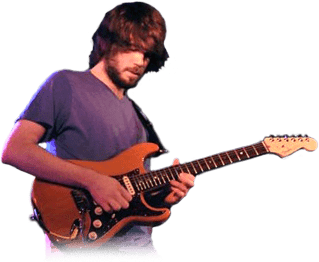
Hi everybody! My name is Mike Salow. I’m a fusion/rock guitarist living in Minneapolis/St. Paul (Twin Cities), MN in the U.S. I recently graduated with honors from McNally Smith College of Music receiving a B.M. in guitar performance with a music business minor. Most of the work I’ve done has been with fusion, funk, jazz, blues, metal, pop, and rock bands/ensembles and on occasion, I do classical work for weddings.
Currently I’m lead guitarist & backing vocalist for Minneapolis based rock band, Chester Bay. After I joined the band in September of 2009, Chester Bay toured throughout the upper Midwest, was featured in Rolling Stone magazine, and also opened for national acts such as Candlebox, Eric Church, The Bodeans, Los Lobos, Fitz and the Tantrums, and The Avett Brothers. As of late I’ve also been playing with local indie/hip-hop group, Munqs as well as hip-hop artist Ceewhy.
I’ve been teaching freelance guitar & bass lessons for the past five years through Skype and in person. For the past 3 years I’ve been teaching at several schools around the Twin Cities including School of Rock, Cyprus School of Music, and Schmitt Music’s Rock Star Academy.
I’ve been fortunate enough to be seen on truthinshredding.com, as well as receiving an Outstanding Solo award at the Elmhurst Jazz festival, in Chicago, IL, with the Kirkwood Community College Jazz Big Band, and I’ve also had success in select guitar competitions via YouTube, placing 1st in one and being a top 12 finalist in another.
So please feel free to roam around my page and check out my guitar lessons! Thanks,
Mike
Mike's Lessons
Display
Type
Sort
Hello again! In this tutorial, we are going to talk about open voiced triads. What are open voiced triads? Well, to understand open voiced triads is might be best to first learn what c...
On to the minor triad. We'll be using the same key center of D but will be playing of the 2 chord, E minor. Root inversion with the root in the bass. 1 - 5 - b3 1st inversion wit...
Next, the diminished triad. Again, we'll be in the key of D but this time we're using the 7 chord, C# diminished. Root inversion with the root in the bass. 1 - b5 - b3 1st invers...
Hi all! Back with another tutorial! This time we'll be looking at three licks in the style of Eric Johnson. All of these licks will be focused around sixteenth note E minor pentatonic runs....
The second lick is almost a continuation of the first lick. It starts off the b7 (D) of the E minor pentatonic scale which is in the G position of the caged system. It quickly shifts into t...
The final lick explores the other postions of the pentatonic slightly more than the first and second. We start at the top of the Gm position of the CAGED system and dscend into the Am posit...
Hi all! Welcome back to another tutorial. This time around we'll be discussing rhythmic displacement within metal guitar riffs. The first thing I need to point out is that we will be...
First, we will take a look at the original rhythm in which our example stems from. This rhythm fits perfectly within one measure in 4/4 but soon we will throw it all off with our displacemen...
Moving onto the breakdown of the example riff. As I mentioned in the previous videos and verbally within this video, we will add a 16th note rest to the original rhythm creating the d...

Hi all! Back once again with another Infinite Guitar tutorial. This time I thought it might be fun to discuss artificial harmonics. I was first interested in this technique when I...
So in this video we will talk about the basic technique surrounding artificial harmonics. The easiest way to explain this is to say, whatever note is fretted with the left hand will need to...
Now that we've figured out the basics of artificial harmonics, we can now move onto the full technique as heard from players like Tommy Emanuel. This technique will utilize not only artific...
The chords that are used in this example are the following: Bmin7add4 Bbmaj7#4 Cmaj69 C7b5 The voicings used within this example are not typical outside of this technique although...

Hello again Infinite Guitar! What are "money makers"? They are guitaristic fills that are musically pleasing to the listener and are heard mostly in very popular styles of music. In other w...
On to our first approach of using 4th intervals. Although I'm calling these "4ths" they are more like inverted 5ths because in most cases we'll be playing the root and 5th of the current cho...
These Hendrix style double stops will always start will a 4th and grace-note into a minor third. The notes included in the fills will not always be chord tones but the chord tones will ...
Here we have the last couple variations, and we're done! Be sure to recognize that the main duty of these money makers is to very tastefully outline the chords. Each of these will be very "...

It's about time we have an R&B guitar lesson! And in this tutorial we're going to focus on R&B embellishments on two common 7th chord shapes. Over the last couple of years, this...
First, we will talk about major 7th chords. Specifically a drop 2 E major 7th chord with the root on the 5th string. We'll start with the basic voicing of root, 5th, 7th, 3rd, 5th. We'll the...
Now we will talk about minor 7th chords. Specifically a drop 2 E minor 7th chord with the root on the 5th string. We'll start with the basic voicing of root, 5th, b7th, b3rd, 5th. In ...